
In this exploration
Adapted from the supplied PlacementOS product study and public MVP. Usability findings refer to the five-student prototype test reported in the study; proposed MVP metrics are not measured outcomes. The cover shows the supplied six-screen MVP overview.
Make limited preparation time count.
PlacementOS is a decision-support product for college students managing several active internship or entry-level opportunities. It brings deadlines, application stages, requirements, profile evidence and personal interest into one view, helping students choose their next preparation action and allocate the time they have.
The project moves from discovery and segmentation through feature prioritisation, prototype testing and a publicly deployed functional MVP built with AI-assisted development. The central question remains practical: given these opportunities and this week’s constraints, what deserves attention first? Product value depends on making that decision easier, rather than predicting who will receive an offer.
The difficult part starts after discovery.
The supplied study reports that participants already found opportunities through placement portals, LinkedIn, referrals and company sites. Recurring difficulties concerned interpreting mandatory versus preferred requirements, choosing between assessments and interviews, and deciding which missing skills were worth practising. Application tracking supported these decisions but was less differentiated as a standalone offering.
Segmentation focused the product on third- and fourth-year students with overlapping opportunities and limited preparation time. Frequently shortlisted students emerged as a potentially high-need subgroup. The study treats the frequency and severity of overlapping demands as only partially supported; whether recommendations change behaviour remained unvalidated. The discovery interview sample size is not specified, so these findings are directional.
| Question | Status in the supplied study |
|---|---|
| Can students distinguish critical requirements and useful preparation? | Difficulty reported in the current interview sample. |
| How often do several opportunities compete for time? | Partially supported; frequency and severity need validation. |
| Will students act on a recommendation? | Not established by problem interviews. |
| Will recurring skill gaps change preparation choices? | Requires testing of the proposed solution. |
Build around the next decision.
The opportunity map separated four needs: prioritising opportunities, interpreting requirements, identifying recurring gaps and dividing preparation time. Prioritisation and time allocation took precedence because they directly address competition for attention. Requirement analysis and skill evidence support that choice; they are inputs rather than the entire product.
V1 therefore concentrates on comparison, explainable recommendations, preparation allocation and user overrides. Job discovery, resume rewriting, generic career chat and automated calendar integration were excluded. The product principles favour inspectable reasoning and low entry effort. Missing dates or ambiguous requirements should prompt review instead of a confident-looking answer built on incomplete information.
| Direction | What it offers | The trade-off |
|---|---|---|
| Opportunity comparison + preparation allocationWorking direction | Connects competing needs to a concrete next action | Requires accurate context and understandable rules |
| Requirement analysis + tracking | Supplies evidence, deadlines and stages | Useful support; limited differentiation alone |
| Discovery, rewriting and automation | Broadens the career workflow | Adds scope before the core value is established |
From opportunities to an editable plan.
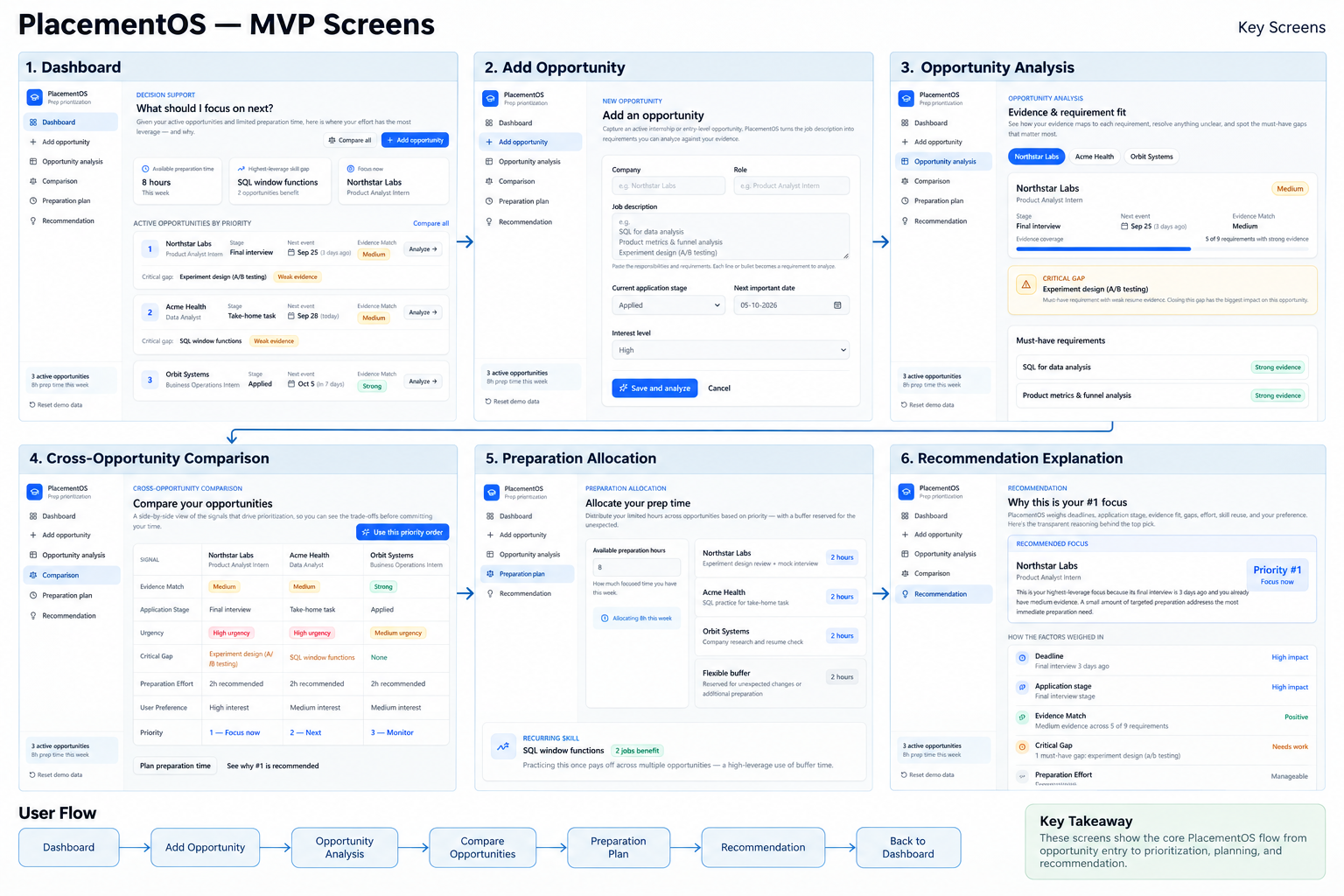
The experience connects a dashboard, opportunity entry, requirement analysis, comparison, preparation allocation and an explanation screen. The proposed decision signals include deadline urgency, application stage, evidence match, critical gaps, preparation effort, skill reuse and preference. A gap repeated across important roles may deserve more time than an isolated missing skill.
The public MVP makes the core flow interactive using explicit rules and browser-stored state. Pasted job descriptions produce editable starter requirements; this is not a trained hiring model or a proven automated skill assessment. Students can inspect the rationale and override priorities. The result should answer what to do first, why, how much time to spend and what follows.
- 01
Capture
Add opportunities, deadlines, stage and preference.
- 02
Compare
Review evidence, critical gaps and recurring skills.
- 03
Allocate
Use an available-hours budget to suggest preparation.
- 04
Decide
Read the rationale, follow it or override the plan.
Understanding the order was only part of trust.
The study documents a prototype test with five college students applying for internships or entry-level roles. Each received the same scenario: three opportunities and eight preparation hours. Tasks covered finding the top priority, understanding its reason, checking a gap, comparing opportunities, reviewing allocation and disagreeing with the recommendation.
Three of five completed the overall flow without help. Four understood the ranking and four understood the allocation. Participants questioned factor weights, the meaning of Evidence Match, the flexible buffer and how to change priorities. These are findings from a small prototype usability study; they do not establish sustained adoption, time savings or improved hiring outcomes.
- 013 / 5
- Completed the overall flow without assistance.
- 024 / 5
- Understood opportunity ranking.
- 034 / 5
- Understood preparation-time allocation.
Explain the recommendation. Preserve control.
Testing led to specific design decisions: clarify that Evidence Match describes profile support for requirements, explain buffer time, retain editable allocation and make overrides available. Critical-gap explanations should show requirement importance and evidence strength. Together, these changes address uncertainty at the point where a student decides whether to follow the plan.
| Observed confusion | Design response |
|---|---|
| Evidence Match sounded like selection probability | Explain that it measures supporting profile evidence. |
| The ranking factors were not transparent enough | Keep the explanation of urgency, stage, gaps, effort, reuse and preference. |
| Why leave time unallocated? | Explain the buffer for unexpected interviews or extra preparation. |
| Personal priorities differed from the recommendation | Keep overrides and editable time allocation. |
| Why is one missing skill critical? | Show must-have/preferred status and the available evidence. |
Measure the action after the answer.
The proposed North Star is Priority Action Completion Rate: the share of active users completing at least one recommended high-priority action after reviewing their opportunities. Supporting measures cover activation with two or more opportunities, comprehension, acceptance, usefulness and time to decide. Guardrails include entry effort, requirement-classification errors, false skill matches and override patterns.
These are proposed measures, not reported MVP results. Next, test the working product with real preparation weeks and investigate why recommendations are accepted or changed. Trust depends on useful explanations and room for personal context. The next iteration should improve that decision before adding more automation; offer rates alone cannot isolate the product’s contribution.